
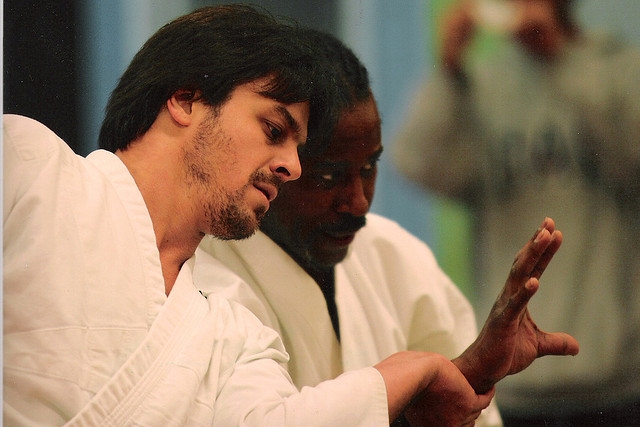
Last week we spoke about the advantages of using the Aikido way to deal with conflict. We said it's better if you use "entering and blending" first. In this position, you are looking at the situation from the other's viewpoint but without giving up your own viewpoint. This immediately changes the energy of the conversation allowing the two of you to approach the conflict from the same perspective and to build understanding.
Today I'm going to give you 6 guidelines for effectively turning conflict around using the Aikido way of blending.
Guidelines on the art of blending
1. Blend from a grounded and centered stance.
Whether it’s a physical attack, like in Aikido, or a verbal attack, you need to be firmly centered as you blend. The Japanese would call the to concentrate your energy in your hara belly. They teach you to put your attention on the soles of your feet and below your navel.
If you receive a verbal attack while seated, put your attention on your buttocks and the small of your back as well as on the soles of your feet. Sink into your chair. Feel the small of your back on the backrest. Let your shoulders remain relaxed and supple and make sure your breathing doesn't rise into your upper chest. Let your breath expand your hara, and if the attack is verbal, speak slowly and with genuine feeling as you respond.
2. Don’t overblend.
Responding to a verbal attack by saying something like, “Yes, you're right and I'm wrong and I'm a bad person,” isn't blending. By doing that you bring the attention back to yourself rather than truly looking at the situation from the other's viewpoint. Stay grounded and centered. Honor your view point while seeing the situation from the other’s viewpoint. Sometimes a blend involves an apology, but blending isn't just giving in or denigrating yourself. It's seeking harmony through a reconciliation that honors both viewpoints.
3. Don’t overuse it.
Blending is extremely powerful. Using it all the time can drive people close to you crazy. There are times when people want to and need to grapple with one another verbally, to have an old-fashioned give-and-take. Blending isn't the only way to deal with incoming energy.
4. Do it wholeheartedly.
The inadequacy of a less-than-wholehearted physical blend is dramatically revealed in Aikido. If you make a halfhearted attempt at blending while hurrying to pull off a technique, the technique is almost sure to fail. The same thing is true in verbal blending. The blend isn't just a trick with which to fool and adversary. It involves true understanding of the other person's intentions and feelings. Ideally, a verbal blend conveys this understanding. It involves empathy. It comes from the heart.
5. Practice!
Blending is one of those rare skills that sometimes produces immediate good results. But to blend consistently and to do so under pressure requires a great deal of practice. Start simply by listening carefully and sympathetically to everything people say to you. Remember, this doesn't necessarily mean agreeing. When you get really good at this, you might be surprised at how successfully you can blend under pressure.
6. Come from an attitude of collaboration and harmony.
To blend is to move toward the attack, creating a dance that joins attacker and defender and opens the way to reconciliation. It yields reliable good results, but it really isn't about winning. Blending is an expression of love and care.You need to be willing to embrace even the strongest attack and bring it into a circle of concord that somehow connects each individual to the essential unity and harmony of the universe.
When blending doesn’t work.
If you have tried blending, and it doesn’t work, you might have to strike effectively after blending. In physical Aikido, as a matter of fact, a successful blend almost always creates an opening for a throw or a pin. In some cases, pushing back, standing your ground, and striking out forcefully is necessary or appropriate.
If values or principles are involved, you might have to stand your ground. If you try to appease or influence a bully, you might fail to maintain your own point of view, which is essential to the successful practice of blending. But you can’t lose your grounding and just strike. You have first to use the blending maneuver.
Remember. . .
Blending isn't the answer for every situation, but it should always be the first answer. It's a means by which you can multiply your options in responding to any kind of attack.
Do you need to improve your dialogue skills to “enter and blend”? Don’t lose valuable time. Contact me today for a free, no obligation interview to decide how can I help you.
( Ideas taken from: The Way of Aikido: Life Lessons from an American Sensei by George Leonard)
Photo by: tharso